
Moving Mindsets from Problems to Solutions
coaching communication communicationskills language leadershipdevelopment nlp professionaldevelopment Feb 03, 2026
One simple shift that can change a team culture.
There’s a very simple technique I’ve used for years that can genuinely shift a team from being problem-focused to solution-focused.
It’s not complicated.
It’s not theoretical.
And it works remarkably quickly.
What makes it powerful is the language.
Because your brain is compelled to answer any question you ask it.
And most of the time, without realising it, leaders ask questions that keep people stuck in the problem.
Why Problems Feel Bigger Than They Are
When someone says, “I’ve got a problem,” notice what happens next.
Very often the response is, “What’s the problem?”
That alone strengthens it.
In NLP (neuro linguistic programming) terms, a “problem” is what we call a nominalisation - That is something that is described as a noun or thing - but in reality is an action.
You can’t go to a shop and buy two kilos of problems.
It’s simply a perspective on a set of circumstances.
And the moment we change the language, we begin to change the thinking.
Step One: Let the Brain Explain Itself
If someone brings you something they see as a problem, begin by asking them to write down three reasons why it’s a problem.
Just three.
“Why is that a problem?”
“And what else?”
“And what else?”
The word why gives the brain a reason. It draws out motivation and meaning. You will get all the reaosn for the problem and you are keeping stuck in the problem
The Question That Changes Everything
Instead of asking, “What are you going to do about it?” ask:
“What needs to happen to resolve this situation?”
Notice the difference.
The moment you say, “What do you need to do?”, the person feels responsible for having the answer. If they’re already stuck, that can keep them there
But when you ask, “What needs to happen?”, you send the brain into search mode.
It begins looking for possibilities.
You then invite them to write down five things that would need to happen for the situation to be resolved. Not perfect answers. Just possible ways forward.
If they hesitate, simply say, “And what else?”
That small phrase presupposes there is more.
And most of the time, there is.
What This Does to a Team
I’ve seen this shift team cultures surprisingly quickly.
Leaders I’ve worked with have told me that within a week or two of using this approach consistently, something changes.
Instead of people arriving with, “Here’s the problem - fix it,” they begin arriving with, “Here are two possible solutions. Which do you think is stronger?”
That’s a completely different mindset.
They’re still seeking guidance. But they’re thinking. They’re taking ownership. They’re moving forward rather than circling the issue.
And that’s how a culture changes - through language repeated over time.
Your State Matters More Than You Think
There’s another subtle piece to this.
If someone says, “I’ve got a problem,” and your tone matches their frustration - “Oh no, what’s the problem?” - you’ve just reinforced it.
Instead, respond neutrally.
“Okay. Tell me more about the situation.”
That one word - situation - reduces emotional intensity.
You’re not dismissing the issue. You’re simply framing it in a way that invites thinking rather than emotion.
Leadership isn’t just about what you say. It’s about how you say it.
Try It Yourself
Before you use this with your team, try it personally.
Take something that’s been bothering you.
Write down three reasons why it feels like a problem.
Then ask yourself:
“What needs to happen to resolve this?”
Keep going until you’ve written at least five possible shifts, actions or changes.
Then choose one to begin with.
You’ll feel the difference almost immediately.
Moving from problem-focused to solution-focused isn’t about ignoring difficulty.
It’s about changing the direction of attention.
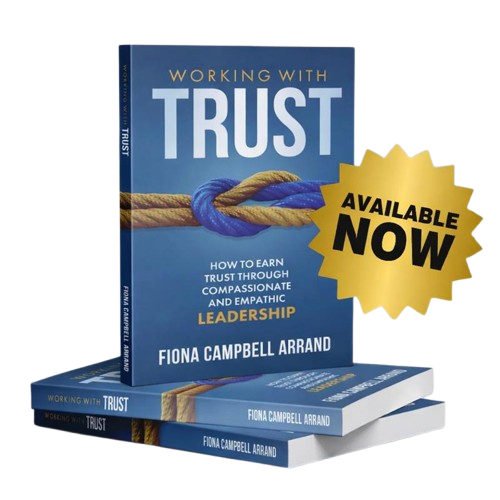
If you’d like more practical leadership tools grounded in language, mindset and trust, you may enjoy my book, Working with Trust.
___________________________________________________________________________________________________

Click here to learn more about our courses

Click Here to Learn More about our NLP Business & Coaching Community
_______________________________________________________________________________________
Fiona Campbell Arrand works with leaders and coaches to build trust, clarity and stronger workplace conversations.
BUILDING CONFIDENCE,
CLARITY AND TRUST AT WORK
Sign up now for your Free Guide.
We hate SPAM. We will never sell your information, for any reason.