
The Leadership Habit That Builds Trust Faster Than Anything Else
coaching communicationskills leadership development leadershipdevelopment listeningskills trust Mar 17, 2026Listening Properly
Let me ask you something.
When someone is talking to you, are you really listening, or are you quietly preparing what you’re going to say next?
Most of us would like to think we’re good listeners. You hear the words being said, you nod at the right moments and the conversation moves forward. But hearing and listening are not quite the same thing, and when it comes to building trust in leadership, the difference between the two matters more than you might realise.
When You Feel Properly Heard
Think for a moment about the last time someone genuinely listened to you. Not the polite kind of listening where the other person looks attentive but is clearly distracted, and not the rushed conversation where someone jumps in with advice before you’ve finished explaining your point.
I mean the kind of listening where the other person is fully present and genuinely interested in understanding what you are saying.
When that happens, something shifts in the conversation. You find yourself explaining things more clearly, perhaps sharing a little more than you originally intended and feeling more relaxed as the discussion unfolds. Without anyone needing to say the word trust out loud, it begins to grow naturally because the experience feels respectful and balanced.
When Conversations Move Too Quickly
If you think about the conversations you have in a typical working day, you may notice how quickly many of them move. Someone raises an issue, you respond with a solution and the meeting moves on.
It can feel efficient and productive. But sometimes that speed comes at the cost of understanding.
When you move too quickly into fixing mode, you may unintentionally signal that the conversation itself is not that important. Over time, people begin to share less detail, not because they don’t care, but because they are not entirely sure anyone is truly interested in hearing the full picture.
Listening Is More Than Hearing Words
Another reason listening matters so much is that communication is never just about the words someone uses.
As you listen, you may start to notice tone, pace and body language as well. Someone might say, “Yes, that’s fine,” yet their voice sounds slightly tight or their posture suggests hesitation.
When you begin to pay attention to those signals and respond with curiosity rather than assumption, your conversations change. Instead of responding only to what was said, you begin to understand what might be happening underneath it.
And that deeper understanding is where trust begins to strengthen.
Listening Creates Psychological Safety
When someone feels that you are genuinely listening to them, something important happens internally. People begin to relax because they feel that their perspective matters and that they are not going to be interrupted, dismissed or judged too quickly.
This is where listening quietly creates something very powerful in a team — psychological safety.
When people feel safe enough to speak honestly, they raise concerns earlier, ask questions more openly and share ideas that might otherwise have stayed in their heads. Instead of waiting until a problem becomes serious, they bring things forward while they can still be addressed constructively.
You may also notice that people become clearer in their own thinking as they talk. Often the act of explaining something to someone who is genuinely listening helps them make sense of the situation themselves.
In that way, listening does more than gather information. It creates an environment where people feel comfortable contributing fully, and that sense of safety is one of the foundations of trust in any team.
A Small Shift You Can Try
If you want to experiment with this, try slowing down the next conversation you have.
Instead of moving quickly to a solution, stay curious for a little longer. Allow the other person to finish their thought completely, ask one more question than you normally would and notice not only what they say but how they say it.
You may find the conversation becomes richer and more productive almost immediately.
When people feel properly listened to, the tone of the relationship changes and trust begins to deepen naturally.
Trust rarely appears in dramatic moments. More often it develops in everyday conversations where people feel respected, understood and genuinely heard.
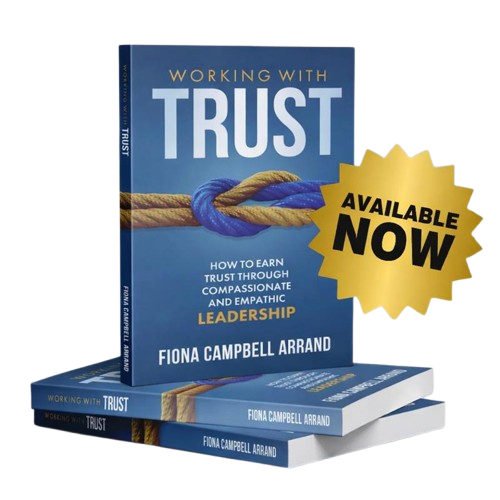
If you’d like more practical reflections on how everyday leadership behaviours build trust, you may enjoy my upcoming book, Working with Trust.
Fiona Campbell Arrand works with leaders and coaches to build trust, clarity and stronger workplace conversations.
___________________________________________________________________________________________________
Click here to learn more about our courses

_______________________________________________________________________________________
BUILDING CONFIDENCE,
CLARITY AND TRUST AT WORK
Sign up now for your Free Guide.
We hate SPAM. We will never sell your information, for any reason.