
When Leaders Avoid Clarity
coaching communication communicationskills leadership development trust workingwithtrust Mar 05, 2026And what it could be costing your team
There is something many leaders underestimate.
The cost of avoiding clarity.
Not deliberately, of course. More often it appears in small ways that seem harmless at the time. You soften a message, delay naming a decision or wrap feedback in so much cushioning that the real point becomes difficult to recognise.
Usually your intention is good. You may feel you are being considerate, protecting morale or giving someone space to work things out for themselves. It can feel kinder to soften the edges of a difficult message than to say it plainly.
Yet uncertainty often creates far more tension than clarity ever does.
When the people around you are unsure where they stand or what you expect from them, their minds naturally begin trying to fill in the gaps.
Why You Might Soften the Message
Most leaders don’t avoid clarity because they are careless. In fact, it is usually the opposite.
You care about the people you work with and the relationships you have built. You don’t want to damage trust or appear unnecessarily harsh. You may worry that speaking too directly could feel critical or discouraging.
So instead of stating something clearly, you hint. Instead of deciding openly, you suggest possibilities. Instead of naming the issue directly, you circle around it and hope the meaning becomes obvious.
But while the intention behind that approach is thoughtful, the result is often quite different from what you hoped for.
Your team have to try and figure out what you mean.
What Uncertainty Does to Your Team
When you avoid clarity, the people around you naturally try to work things out for themselves.
They begin second-guessing whether they have understood correctly. They check with colleagues to see how others interpreted the conversation. They start paying attention to tone, pauses and subtle signals, trying to read meaning between the lines.
You can often feel the shift when this happens. Energy that could have been directed towards performance, creativity or solving a problem is focused of try to figure out what you mean.
And interpretation is exhausting.
Clarity does not remove challenge. Sometimes it brings a difficult issue more clearly into view. But what clarity does remove is confusion, and confusion drains far more energy from a team than an honest conversation ever will.
How Clarity Strengthens Trust
Interestingly, trust often grows when people know exactly where they stand, even when the message they hear is not particularly comfortable.
When you communicate expectations clearly, people know what they are working towards. When feedback is direct and respectful, people understand how they can improve. When decisions are explained calmly, your team can move forward with confidence.
People may not always agree with every decision you make, but they understand the direction and the reasoning behind it. That sense of steadiness allows people to relax into their work because they are no longer trying to guess what the real message might have been.
And that quiet confidence in leadership is one of the ways trust grows.
A Moment to Reflect
It can be useful to pause and ask yourself a simple question.
Is there anywhere right now where you might be avoiding clarity?
Perhaps there is a decision that needs to be named more directly, an expectation that would benefit from being restated or a conversation that ended politely but not quite completely.
Clarity does not require harshness, and it certainly does not require confrontation. What it usually requires is a combination of calmness and courage - the willingness to say what needs to be said in a way that is respectful and steady.
When you do that consistently, your team feels more certain, conversations become easier and trust has the space it needs to grow.
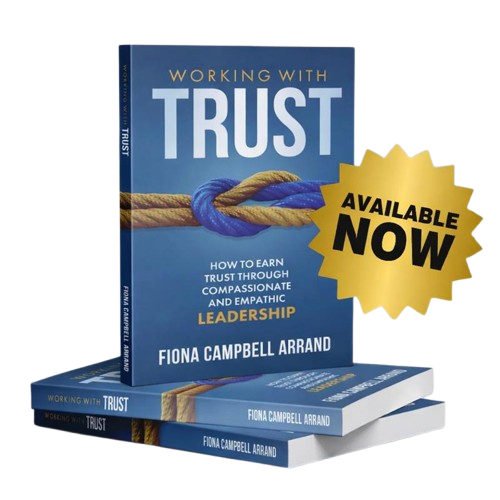
These everyday leadership moments - the conversations you have, the tone you use and the clarity you bring - are exactly the kinds of behaviours explored in my book Working with Trust. Fiona Campbell Arrand works with leaders and coaches to build trust, clarity and stronger workplace conversations.
___________________________________________________________________________________________________
Click here to learn more about our courses

_______________________________________________________________________________________
BUILDING CONFIDENCE,
CLARITY AND TRUST AT WORK
Sign up now for your Free Guide.
We hate SPAM. We will never sell your information, for any reason.